Saturday, January 10, 2015
Stick With Basics
The title says it all. As we all push for new successes in 2015, we're tempted to look for new and improved programs. Especially those of us who are serious competitors. But actually we should focus on basics and tweak little by little.
Let me explain. When I say basics, I'm referring to the basic program method for everyone. A combination of strength with some stabilization along with actually practicing your activity.
When it comes to strength training stick to the 3 or 4 basic weight lifts, the squat, the dead lift, the military press, and possibly the bench press. Later on if your activity calls for it, you can try the explosive lifts, the snatched & the clean and jerk. These exercises could also be done with kettle bells or dumb bells. If you don't have access to weights body weight exercises like push ups, pull ups, and squats will work, though you may have to be creative to increase the intensity. This means push ups with feet elevated or weighted pull ups.
There's been a recent trend emphasizing balance training as well as unilateral training. While there is a place for such training it has been over emphasized. Why do you need to stand on one leg on a balance ball for 10:00? Remember, all activities require strength, which is force production. And that can be best developed by mostly bilateral strength training. Skills, such as running and gymnastic moves, are developed through practice, and all require a basic level of strength, which again, is best developed through strength training ( read Mark Rippetoe's excellent article for a detailed analysis ).
So remember, strengthen yourself with the basics, practice your skill/sport, eat properly, and 2015 will be a success.

Saturday, December 13, 2014
More About Pyramid Workouts
As you remember, last time I told you I reached 9 pull ups using the pyramid system. I did 1 pull up alternating with a 1 leg squat aka "pistol squat", then 2 pull ups, and so on until I hit 9 pull ups, then down the pyramid with 8 pull ups and so on until I was back down to 1. I then did a second pyramid going up to 7 reps and down to 1, all alternating with a 1 leg squat.
Well for the last two weeks I've been able to go up to 10 reps on the first pyramid, 7 reps on the second pyramid along with 2 pistol squats between each pull up. To round up the numbers I did an extra pull up along with two extra sets of pistol squats.
Add it up. That's 150 pull ups and 70 one leg squats in a workout! You read that right.
While I did pull ups this system is good for most exercises. You could do a pyramid system with push ups, sit ups, etc.
Remember some guidelines. Don't go to failure. 75% of your max is probably the most you want to go to and depending on the number of pyramids you do you may want to stop at 50 %. So if your max push ups is 20, you could go 2,4,6,8,10 then down 8,6,4,2. That's 50 push ups. You could rest between each set or better yet do a different exercise. So you could do pull ups, sit ups, squats,etc as long as it works different muscles along with a different motion. By that I mean you want to alternate a pushing exercise with a pulling exercise or a squatting or hinging exercise. For the reps your other exercises could also be pyramided or just a constant number, ie sets of 5 squats.
This method is a great way to get a high volume work without working to failure. By high volume we mean total high reps but using low - sub maximal reps over several sets. This method trains your central nervous system along with increasing difficulty and fighting fatigue. It also allows for a warm up, sub max effort, as well as a cool down.
Another thing to remember is make sure you have the time. Although the above example is relatively small if you were to go up to 20 push ups you would definitely need more rest between sets, thus more time. In my pull up pyramid above, that took over an hour. So adjust to your own schedule.
Also a pyramid workout shouldn't be done more than twice a week. By that I mean you shouldn't do a pull up pyramid more than twice; however you could do a push up pyramid with another exercise once or twice a week and then do a pull up pyramid once or twice a week. In fact, a couple of times I've done a pistol squat pyramid going 1,2,3,2,1 alternating each rep with 5 pull ups, over 4 pyramids, thus totaling 36 pistol squats and 100 pull ups. Notice that while the pistol squats increased the pull ups stayed relatively low, at just 5 reps. Then the next day or a couple of days later I'd do the pull up pyramid.
If you wanted to round it off you could do an extra set or two. In fact, tonight I did my pull up pyramids up to 10 and back down , then up to 7 and back down but rather than stop at 150 pull ups I chose to go 160, so I did one more set of 10. Barely! That goes back to what I said earlier, about getting enough rest between sets. Although I made it was hardly perfect. In addition, I did an extra set of 2 pistol squats, then 3 sets of 3 , alternating each set with 25 reverse crunches. That's also a total of 75 one leg squats and 100 reverse crunches! And in case you're wondering, this workout took over an hour and a half.
You could also do multiple pyramids with lower reps. What's possible for some isn't possible for others. So if you're max pull ups is 10, you could go 1,2,3,4,5,4,3,2,1 which equals 25 reps, then do 3 more pyramids. That's 100 pull ups, while at the same time avoiding failure.
Pyramids are one excellent way to get a high rep workout in a workout. While there are other ways to get a high rep workout in ( which I'll go over in future posts ) pyramids allow you to reach your goals in a progressive, safe, manner.
Well for the last two weeks I've been able to go up to 10 reps on the first pyramid, 7 reps on the second pyramid along with 2 pistol squats between each pull up. To round up the numbers I did an extra pull up along with two extra sets of pistol squats.
Add it up. That's 150 pull ups and 70 one leg squats in a workout! You read that right.
While I did pull ups this system is good for most exercises. You could do a pyramid system with push ups, sit ups, etc.
Remember some guidelines. Don't go to failure. 75% of your max is probably the most you want to go to and depending on the number of pyramids you do you may want to stop at 50 %. So if your max push ups is 20, you could go 2,4,6,8,10 then down 8,6,4,2. That's 50 push ups. You could rest between each set or better yet do a different exercise. So you could do pull ups, sit ups, squats,etc as long as it works different muscles along with a different motion. By that I mean you want to alternate a pushing exercise with a pulling exercise or a squatting or hinging exercise. For the reps your other exercises could also be pyramided or just a constant number, ie sets of 5 squats.
This method is a great way to get a high volume work without working to failure. By high volume we mean total high reps but using low - sub maximal reps over several sets. This method trains your central nervous system along with increasing difficulty and fighting fatigue. It also allows for a warm up, sub max effort, as well as a cool down.
Another thing to remember is make sure you have the time. Although the above example is relatively small if you were to go up to 20 push ups you would definitely need more rest between sets, thus more time. In my pull up pyramid above, that took over an hour. So adjust to your own schedule.
Also a pyramid workout shouldn't be done more than twice a week. By that I mean you shouldn't do a pull up pyramid more than twice; however you could do a push up pyramid with another exercise once or twice a week and then do a pull up pyramid once or twice a week. In fact, a couple of times I've done a pistol squat pyramid going 1,2,3,2,1 alternating each rep with 5 pull ups, over 4 pyramids, thus totaling 36 pistol squats and 100 pull ups. Notice that while the pistol squats increased the pull ups stayed relatively low, at just 5 reps. Then the next day or a couple of days later I'd do the pull up pyramid.
If you wanted to round it off you could do an extra set or two. In fact, tonight I did my pull up pyramids up to 10 and back down , then up to 7 and back down but rather than stop at 150 pull ups I chose to go 160, so I did one more set of 10. Barely! That goes back to what I said earlier, about getting enough rest between sets. Although I made it was hardly perfect. In addition, I did an extra set of 2 pistol squats, then 3 sets of 3 , alternating each set with 25 reverse crunches. That's also a total of 75 one leg squats and 100 reverse crunches! And in case you're wondering, this workout took over an hour and a half.
You could also do multiple pyramids with lower reps. What's possible for some isn't possible for others. So if you're max pull ups is 10, you could go 1,2,3,4,5,4,3,2,1 which equals 25 reps, then do 3 more pyramids. That's 100 pull ups, while at the same time avoiding failure.
Pyramids are one excellent way to get a high rep workout in a workout. While there are other ways to get a high rep workout in ( which I'll go over in future posts ) pyramids allow you to reach your goals in a progressive, safe, manner.
Saturday, November 22, 2014
Pyramid To Success
As mentioned last time, I hit a new max in my pull ups ,15 ,& 1 leg squats ( aka pistol squats ), 6 . One of the best methods that got me there was the pyramid method. Once a week I would do pull ups, going up to a certain number, then go back down.
So a couple of weeks ago, I would go 1,2,3,4,5,6,7, then go down 6,5,4,3,2,1. I would do a 1 leg squat between each set of pull ups. Therefore, this equaled 49 pull ups & 13 pistol squats. But I would in fact go up & down the pyramid a second time, thus giving me 98 pull ups & 26 pistol squats. And I'd do an extra sets of 2 just to make it to 100 for the day!
Yesterday I did a pull up pyramid up to 9 , and then a second pyramid up to 7. I alternated 1 pistol squat up to 9, then I did 2 pistol squats between each of the remaining sets. That's 1,2,3,4,5,6,7,8,9,8,7,6,5,4,3,2,1,1,2,3,4,5,6,7,6,5,4,3,2,1 . Total 130 pull ups and 51 pistol squats!
This method can be used with most exercises. In fact, I did a similar workout with pistol squats where I went 1,2,3,2,1 alternating 5 pull ups between each set. I did this 4 times, thus giving me 36 pistol squats and 100 pull ups.
A few things to keep in mind. Don't go to your max. 50% - 75% is good. For example, if your max push ups are 20, go up to 10, 15 at most, and even that's pushing it. Also, it's a good idea to put another exercise between each set, although it doesn't have to be pyramided. This way, you stay active and make your time more productive. Speaking of time, make sure you have the time. This is especially true of high rep workouts. That 9 pull up pyramid took over 30:00 and the total time was close to an hour. Trust me, when you go to high rep strength endurance work outs, you'll need some rest between the higher rep sets. If you don't have the time do another type of work out. Finally, I wouldn't recommend doing the same pyramid workout more than once a week. Especially when you get to higher reps. While I did do a pistol squat pyramid and a pull up pyramid this week, I didn't do them twice or more this week.
I hope to hit 10 pull ups in a pyramid workout soon. That'll be 100 pull ups, but reached faster. Hopefully, soon I'll be doing 20 pull ups overall. So if you want more reps in a specific exercise, and you've got the time, give this pyramid scheme a try.
Monday, November 10, 2014
SEAL Museum 5k 2014 & Murphy Challenge
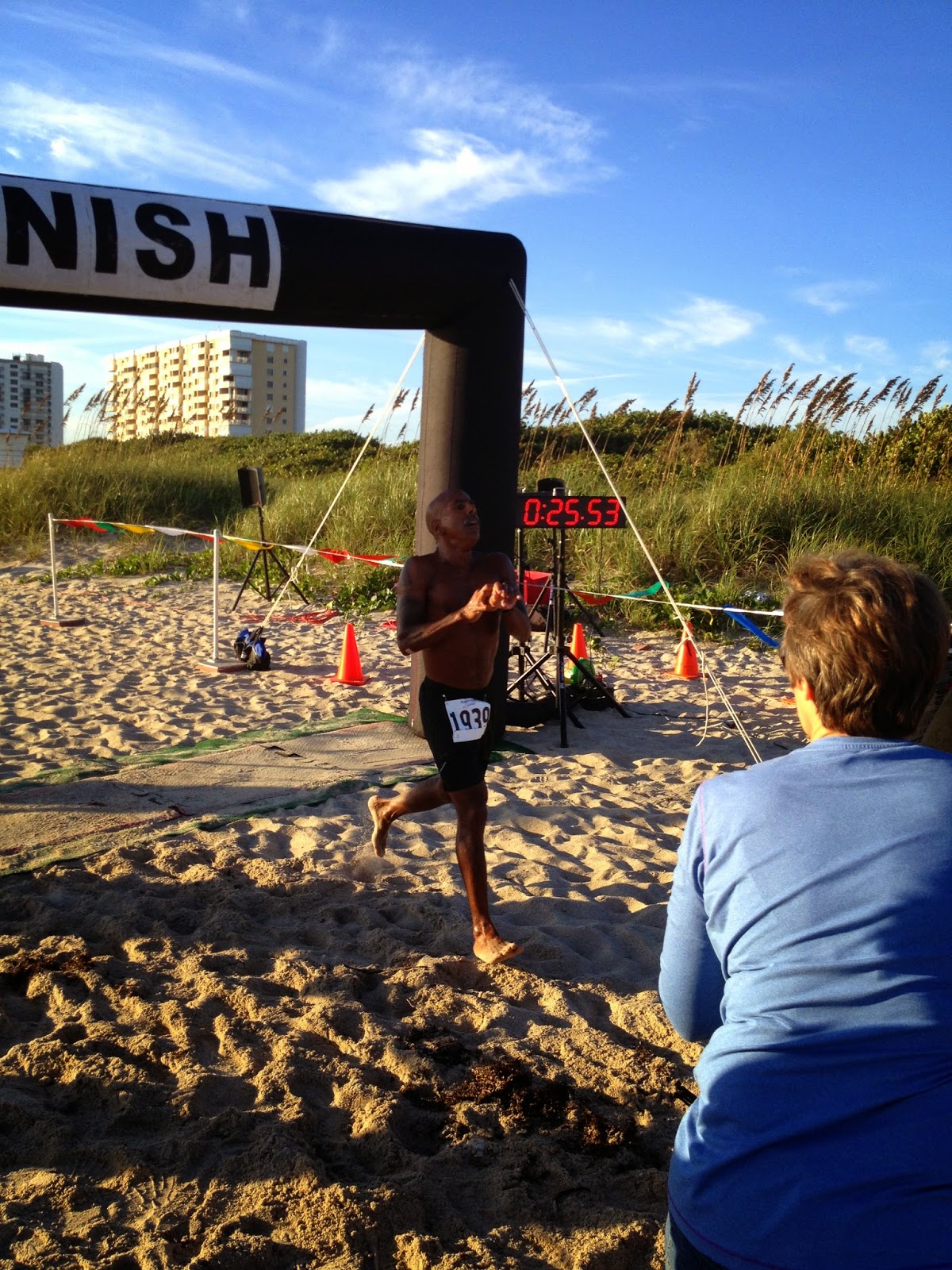
Well I competed in my 7th SEAL Museum 5K. I came in second in my age group, 23rd overall with a time of 25:51. While it was ok I should have done better. There are things like hip mobility & v02 max to work on.
I did however set new personal bests in 2 other areas. After the awards ceremony I went to the beach and did my 100 burpees for the day non stop, then a new record for pull ups, 15, & 6 one leg squats on my right leg, 7 on my left leg! Was this tough? Need you ask?! And I won't lie, there were pauses ( but I never jumped off the pull up bar or put the opposite leg down).
Continuing with new challenges/accomplishments, today in honor of Veterans Day, I did the Murph Challenge. It's named in honor of the late SEAL Lt. & Medal of Honor winner Michael Murphy. It's a workout he did before deploying to Afghanistan. Run 1 mile, then do 100 pull ups, 200 push ups, & 300 squats, & run 1 more mile! Yes, you read that right. And he did this all while wearing a 40 lbs vest & boots!
I modified it a little to put it mildly. I wore sneakers on the run, no weighted vest or any shoes on the exercises, and I did them in 20 sets of 5 pull ups, 10 push ups, & 15 squats. It me 59:04. The first mile was 8:55, the second 8:16. It was certainly an "interesting" way to start the week!
While such challenges aren't for beginners they are something to work towards. Always stay motivated, work hard but smart & practical. That's how you make progress.
.JPG)

Tuesday, November 4, 2014
Update
Sorry for the long delay. I'll try to write more often. It's just that I want these posts to be informative and useful and that takes time. I often put short pieces on Facebook so if you want training info send me a friend request at facebook.com under Gopal Rajagopalan.
Well this Saturday Nov. 8 I'll compete in the annual UDT/SEAL Museum 5k. I'm looking for my 4th win in the masters division. Wish me luck. I'm also going to look to break my 13 pull up max and set a new record. At least 14 but hopefully 15 or more. One of the training methods I've been using is intervals of pull ups. Today at the pool, on my two 30:00 breaks, I did 3 pull ups for 20:00 on the minute. That's 60 reps per break which means 120 total today! Last Friday I did the pyramid system where I went 1,2,3,4,5,6,7,6,5,4,3,2,1, once in the afternoon and once at night. I also threw in a set of 2 after I got down to 1 . That means 51 pull ups in both sessions which means 102 pull ups total for the day! I'm debating whether to raise the pyramid to 8 this week.
Just to let you know theses methods are meant to be used no more than twice a week and certainly never day after day. Also make sure you have lots of time , especially in the pyramid system, because you're going to need lots of rest between the higher rep sets.
Train hard and smart!
Thursday, May 1, 2014
Painful Struggle
I've been able to continue my training although at a much lower intensity.
I swam for the first time in several months at Pepper Park. The water was nice and calm, and while I had to be careful with my left shoulder especially, I didn't have nerve pain. I also ran afterwards each day, Saturday finishing with a 6 + mile run from Pepper Park to Avalon Beach and back. Of course at the speed I was going run may be the wrong word. Trotting may be a more accurate description.
I also finished the week with heavy singles in the squat ( 165 lbs) and the dead lift ( 260 lbs ) x 12 sets. I've had to carefully approach pull ups . I have to make sure I don't hyper extend at the bottom position.
Like I say I'm very far from 100%. I did run a barely tolerable 2 miles on Monday, around 18:45. I'm also able to safely average 3 pull ups per set. I am also spending time foam rolling as well as working on mobility exercises and body realignment , such as Tai Chi Chuan, to fix my imbalances. Remember, in most cases it's not the activity that causes injury but rather improper form.
I'll try to finish the week on a good note. Little things like an extra rep or :05 off my run times may be small but they're progression, not regression.
Sunday, April 20, 2014
Slow Start
Sorry I haven't written in awhile. As some of you may know, back in January I strained my right fibula and right latissimus. So of course 2 of my favorite activities, running and pull ups, were out of the question. It was so infuriating. I had hoped to compete in my first marathon, which was also the first marathon here on the Treasure Coast. I think it was also a qualifier for Boston. As for pull ups, I was up to 14 reps. I know if I had kept it up by this time I'd be at minimum 16 , possibly at the big 2-0.
Oh well, no point in crying about it. I know it sounds cheesy but what separates the champs from the chumps is getting back into the grind as soon as you can. Which I have. I also stayed active during this time. Unless you're totally out of the game , such as being on crutches, laid up in bed,etc., it's important to substitute with as much as you can, safely of course. In my case I was able to do most strength training exercises , although overhead presses were limited. Basically I would do kettle bell circuits in the mornings and power lifting exercises at night. With the kettle bell I could do swings and even lunges ( very carefully of course ) in different planes of motion, usually from 45:00 -1:00 +. I did this to simulate aerobic activity although I must say it was too low intense for major results . I also added as time went on, and my fibula and lats healed, step ups ( without added weight ) and push ups ( only shoulder width ).
As for "maximal strength" basically I've been doing squats or dead lifts 4 nights a week . I've used a 5 x 5 routine . 5 sets x 5 reps. Obviously the weight has had to decrease, at least in the beginning. 2 nights I did variations of these lifts like straight leg dead lifts or front squats. What's good about these lifts is they are also a good intro to the explosive Olympic lifts.
In the last few weeks I progressed to the point of full extension of the ankles such as in the snatch and clean and jerk. I also was able to hop over the kettle bell with alternating feet, do low rep jumps, and eventually jumping rope for a few minutes . Jumping rope was really important not only as a step forward ( no pun intended ) but also my first real intensive exercise done for time, my first somewhat aerobic activity . As for pull ups, I tested how I felt by hanging from my pull up bar. I made sure not to hyper extend my arms at the bottom position.
As for the rehab side of the equation, I started off with traditional Chinese bone setting to fix my fibula, then little by little added mobility exercises , foam rolled trigger points, ice of course, practiced my Tai Chi Chuan/Chi Kung to realign my structure as well as for overall health, and took natural supplements like Omega 3 to lower inflammation .
Well, this past Monday, April 14, after about 50:00 of circuits I "ran" my first mile in more than 2 months, running it at about 10:00. I won't lie, it was tough . As for pull ups I did 2. Throughout this week I've run a mile a day after my circuits. A few days I would do 1 pull up as part of my circuits or 2 - 3 later in the day. Friday I ran 2 miles, and Saturday I ran 5 miles.Afterwards I did 5 pull ups. I may have been able to squeeze 1 more in but I wanted to be careful.
Essentially I've focused on my form, avoiding the "do or die" attitude. While I'm not happy about 10:00+ miles or a measly 5 pull ups I think in order to make progress towards 6:00 miles or 20+ pull ups, these steps are necessary ( Boston 2015, Ninja Warrior 2016!). Keep following my progress folks.
Extra special thanks to Charlie Chen, Dr. Aihan Kuhn, Ari Globerman, and Bob Haviland for the extra help, advice, their knowledge, and motivation these people have given me over the years
Oh well, no point in crying about it. I know it sounds cheesy but what separates the champs from the chumps is getting back into the grind as soon as you can. Which I have. I also stayed active during this time. Unless you're totally out of the game , such as being on crutches, laid up in bed,etc., it's important to substitute with as much as you can, safely of course. In my case I was able to do most strength training exercises , although overhead presses were limited. Basically I would do kettle bell circuits in the mornings and power lifting exercises at night. With the kettle bell I could do swings and even lunges ( very carefully of course ) in different planes of motion, usually from 45:00 -1:00 +. I did this to simulate aerobic activity although I must say it was too low intense for major results . I also added as time went on, and my fibula and lats healed, step ups ( without added weight ) and push ups ( only shoulder width ).
As for "maximal strength" basically I've been doing squats or dead lifts 4 nights a week . I've used a 5 x 5 routine . 5 sets x 5 reps. Obviously the weight has had to decrease, at least in the beginning. 2 nights I did variations of these lifts like straight leg dead lifts or front squats. What's good about these lifts is they are also a good intro to the explosive Olympic lifts.
In the last few weeks I progressed to the point of full extension of the ankles such as in the snatch and clean and jerk. I also was able to hop over the kettle bell with alternating feet, do low rep jumps, and eventually jumping rope for a few minutes . Jumping rope was really important not only as a step forward ( no pun intended ) but also my first real intensive exercise done for time, my first somewhat aerobic activity . As for pull ups, I tested how I felt by hanging from my pull up bar. I made sure not to hyper extend my arms at the bottom position.
As for the rehab side of the equation, I started off with traditional Chinese bone setting to fix my fibula, then little by little added mobility exercises , foam rolled trigger points, ice of course, practiced my Tai Chi Chuan/Chi Kung to realign my structure as well as for overall health, and took natural supplements like Omega 3 to lower inflammation .
Well, this past Monday, April 14, after about 50:00 of circuits I "ran" my first mile in more than 2 months, running it at about 10:00. I won't lie, it was tough . As for pull ups I did 2. Throughout this week I've run a mile a day after my circuits. A few days I would do 1 pull up as part of my circuits or 2 - 3 later in the day. Friday I ran 2 miles, and Saturday I ran 5 miles.Afterwards I did 5 pull ups. I may have been able to squeeze 1 more in but I wanted to be careful.
Essentially I've focused on my form, avoiding the "do or die" attitude. While I'm not happy about 10:00+ miles or a measly 5 pull ups I think in order to make progress towards 6:00 miles or 20+ pull ups, these steps are necessary ( Boston 2015, Ninja Warrior 2016!). Keep following my progress folks.
Extra special thanks to Charlie Chen, Dr. Aihan Kuhn, Ari Globerman, and Bob Haviland for the extra help, advice, their knowledge, and motivation these people have given me over the years
Subscribe to:
Posts (Atom)