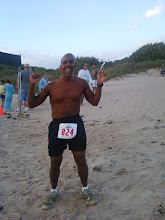
They had us in teams of 2 in 3 different categories, advanced, intermediate & just for fun. I was realistic & chose just for fun. Some of the obstacles had me & my teammate jumping rope 200 times while my partner did lateral hops over a small hurdle, flipping a tire back & forth down a field, dragging a tire , medicine ball throws, rope climbing, swimming out to a boat with an oar , carrying a "victim" ( a 60 lb sandbag) on a stretcher down the beach , over a wall, & back, log lifts, paintball target shots. Being based on SEAL training there were also mind games , such as moving weight disks of different sizes around in correct order , 1 at a time. The final challenge was alternating sets of push press/thrusters with pull ups. Whew!
While this obstacle course challenge was more geared towards SEAL training there are basic similarities between most obstacle challenges ( Battle Frog,Spartan, Ninja Warrior,Cross fit Games,etc). Most consist of some jumping, pulling, short runs, carrying objects, maybe some overhead pressing or throwing of objects. They may also be in tough terrain ( mud, soft sand, hills,etc). Some , like this one, may involve swimming. The main thing is all consist of moving from one activity to another with almost no rest.
Aside from tri athelons, most of these obstacle races often involve using anaerobic energy over an extended time. For example,in one of our early activities we flipped a tire down a field for about 30 meters, then went back the same direction flipping the tire. Our last activity was alternating 3 sets of push presses/thrusters, 65 lbs in our case & pull ups in reps of 21, 15, 9.
As you can see these obstacle challenges aren't for total beginners or people who are deconditioned. However this is something that you as a beginner can use to motivate yourself to train for , something to look forward to ( see my last post on motivation). Intermediate & advanced athletes will find this fun but definitely challenging. I should add, if this is your first obstacle challenge ,even intermediate & advanced athletes may want to consider entering as a beginner if your race allows it. Unless you know all or most of the challenges, & you're 100 % healthy, you're setting yourself up for possible failure. This is what I meant when I talked about finding your weak points & being realistic. Advanced teams were required to do all events. And they had much stricter standards. For example the weight they had to press was much heavier & more reps, they had to dive down to retrieve an object from the bottom of the ocean floor , during high tide & much lower time standards. Obviously in my case I knew because of shoulder problems as well as limited explosiveness, I should enter as a beginner. Currently I can only strictly press an empty 45 lb bar, & only for a few reps. As mentioned earlier, we had overhead presses a few times in the challenge, first on the beach & later at the museum. But because we were beginners , on the beach we allowed to lift 45 lbs, certainly relatively light. And even then I still had to push press. And even worse was a medicine ball press/throw over a pull up bar to my teammate. By the way, this wasn't some firm 5 lb or even 10 lb ball but rather a soft but pretty big medicine ball used for wall throws, thrown over at least a 10 foot bar. Even using my legs, I had a very hard time getting the ball over the bar. Fortunately event organizers allowed our team to do horizontal chest passes to each other. Another event had us jump on & off a big tire. I could only do 1 jump so they let me do step ups. Obviously, I'll have to work on my explosiveness. On the other hand because of my grip & pulling strength I was able to climb a rope & easily handled the pull ups. I should add they expected 6 climbs up the rope , with no rest! However for times sake they let me go with 1. And my teammate's pull ups also counted towards our teams total reps & scores. This is another part of many obstacle races, working in a team. This can help when one of you has a weakness the other team mate can help out. You see what I'm saying about these obstacle races.
I should say, for those of you who are advanced, & especially those of you who want to do "real" challenges ( elite military training, first responder academy,etc) these races are something you may want to consider. The longer the better. Many of them, especially Battle Frog & those hosted by the National Navy/UDT SEAL Museum, are based directly on actual military training. Of course there are major differences, the main thing being these challenges are just a few hours. In the "real deal " ( BUD/S, Air Force PJ Pipeline,Police SWAT/Fire Rescue Academy,etc) you'll be doing these challenges almost all day , 5 - 6 days a week, possibly for several months! However if these are your ultimate goals these challenges are something you should consider trying so as to give you a taste of what to expect, over a long term.
So what should you do to prepare? Basically have a good basic fitness base. This means stabilization & strength which can be developed first through heavy strength exercises & low reps ( squats, overhead presses, dead lifts, maybe balance board training,1 arm 1 leg exercises ,etc). After awhile move on to high rep body weight exercises ( push ups, especially pull ups,etc). Pulling power & grip strength as I've said will be quite important. In almost all of these races there are usually walls to climb over or ropes to climb up. Remember the SEAL Museum Bridge Challenge? We climbed up a 70 foot caving ladder, with a ( fake ) MP 5 strapped to us.Even going down taxed our grip & biceps. Most of these races also usually will have you carry objects for some distance. The farmers walk, walking with an object like a kettle bell, at your side will test your grip & even core strength. This can be developed first through lifting/pulling heavy weight up like the heavy dead lifts ( which can also help with tire flipping),carrying objects ( the Farmers Walk) & very important, working on pulling your body weight which can be developed through high rep pull ups. If you have access, try & climb up ropes. Another major activity in some, but not all of theses races, involves jumping. Either jumping up & down on to an object or jumping over 1 or multiple objects. This will require basic leg strength developed by heavy squats & low reps & then followed by explosive strength which can be developed through plyometric (jump) training. Something I'm working on Of course train carefully, start small & avoid injury. Trust me, I know about that!
Mix up your training to include aerobic & anaerobic training. Your cardio respiratory system will be tested. Short intense bursts spread out over half an hour are a bare minimum to train. Examples might include 50 yard sprints followed immediately by plyometrics ( burpees, jump squats,etc) followed by snatches or push presses ( weights, dumb bells or kettlebells) then sprint back, doing this for several sets with almost no rest.Other areas you may want to train in depending on your race include swimming & training in similar outdoor terrain ( mud, sand,etc). Basically you want to become comfortable being uncomfortable!
This is just a partial list but hopefully this advice will help you conquer as many obstacles as possible. Now go out there & conquer this challenge!
Special thanks to the National Navy UDT/SEAL Museum for hosting , as usual, another incredible event. Obviously thanks to Randall Greer & the crew from Hard Exercise Works Jupiter for putting this incredible event together. And an extra special thanks to my team mate, in team Kick Ass, Richard Moseley. You really helped me get through some tough spots with your shoulder strength, explosiveness & marksmanship! I couldn't have done it without you!
It's late early March as I write this. How many of you have kept up your training? I thought so!
Although this post is oriented more towards beginners even advanced athletes can lose motivation and benefit from the suggestions I'm going to make.
The majority of beginners who quit are usually the type who've made New Years resolutions. Often times they look for easy solutions, quick fixes. Examples include so called starvation, miracle diets (Grapefruit, Nutri- System,etc), diet pills( green coffee bean extract, Garcinia Cambogia,etc), drugs ( HCG), exercise fads ( Biggest Loser). Some even go for surgery! Unfortunately almost all of them end up in failure.
The first thing is to realize is there's no quick fix, no magic bullet. Next , what were you trying to achieve? Things like getting in shape for a wedding, a class reunion, a doctor's visit, and worst of all New Years Resolutions almost always end up in failure. Those are too short term and require unrealistic training. Instead think of a lifestyle change. For example, instead of reaching for ice cream when you feel depressed get up and do a few sets of push ups or presses,etc. If you've been following me, as I've mentioned, I've changed my life dramatically. Instead of counting how much I smoke, nowadays ( 16 years & counting) I count how many gallons of water I drink.
Another thing that goes with a lifestyle change is aiming for new heights. That's why I hate when I hear people say "What's the point of doing 20 pull ups, running a 7:00 mile, dead lifting double body weight,etc?" I can see they're being unnecessarily contrary and they're setting themselves up for failure. I mean why do anything? The feeling of accomplishment is an incredible feeling. In fact, attempting to accomplish something is a major reason to stick to a plan and not give up. While most of us won't become professional athletes we can become competitive people. Maybe finishing a marathon, completing an adventure race, etc. These clearly require a lifestyle change. Obviously junk food, smoking,etc are incompatible with such goals. And for more advanced guys, maybe you want a faster mile or heavier military press as well as maybe you've got wrestling finals coming up or a military test coming up. These clearly require you to stay "clean" and stick to your training plan.
Some of us have come off bad losses maybe. I know, I've been there. In fact my last marathon in February was terrible! I'll go in to more detail in the future. Long story short, I barely made it in 5:30:00. I however haven't stopped training. Instead I'm still running, strength training, eating right,etc. I have however changed my focus, concentrating more on shorter distances and faster speeds a couple of times a week. In fact the following week I ran a 10 K in okay time. In fact each mile was faster than the last, the last 3 miles under 9:00 and the last mile was 7:55. I didn't place but you see what I'm saying. It was a small personal victory but nevertheless a victory. It felt good. I came back doing the best I could.And you can come back. Maybe you'll need to delay your big goal and focus on smaller things. In my case, qualifying for the Boston Marathon is going to have to wait. I'm still doing long distance running but I'm focusing more on 5 K's and 10 K's, maybe even a half marathon. Also you may want to step back and choose easier activities in your training or easier competitions.For example I chose the Fleet Feet Run For Your Heart 10 K, partly because it's a very flat course. A hilly course would probably have had a very different result. Obviously your activities are probably different but the point is the same. See where you're weak, work on those areas, and continue to improve your strengths and eventually you'll rebound.
I hope everyone, beginners and advanced athletes, will think about these things when they feel like giving up. I especially hope beginners will think beyond New Years resolutions or even blood sugar tests and think about the long term possibilities. Think about what you might be able to achieve. Advanced athletes, don't let bad times stop you from working to improve your future performance. Like most topics I write about here , I've personally gone through my ups and downs. However I've been able to overcome these bad times , for the most part. I'll let you know how things go throughout the year. And please let me know how your year goes. Like and follow this blog, and let me know any training questions you may have.
One of the best, and toughest, measures of upper body strength are pull ups. Especially for many military and first responders, pull ups are often part of your test. For SEAL students 20 pull ups is a definite minimum and for Marines , 20 pull ups is part of a perfect score on fitness tests. The Presidents Council on Fitness test in schools, at least used to, also test pull ups. They involve so many muscles, latissimus especially or biceps, forearms, abs, lower back and glutes. Grip strength plays a vital part, and you're lifting your body weight up. Good, honest pull ups work almost everything but your triceps.And even from a cosmetic point of view, pull ups are one of the best back exercises, which in combination with a lean waistline, will really add to that v shaped back look. Unfortunately most people , including men, can barely do even 1.
Seriously, look around in gyms , magazine articles and social media and you'll see numerous articles about how to build big arms or lose weight,etc. Some of those articles are okay but rarely will you see anything describing how to max your pull ups. The fact is pull ups are tough, even 1, let alone 20 reps. I understand because I've been there but like much of my training I tested what worked & what didn't. And now I'll show you how to do pull ups, going from 0 up to 20. So let's get started.
First remember, when we say pull ups, the term usually refers to palms facing away from the body. These tend to work the latissimus more. With the palms facing you usually is called chin ups and the biceps are the main movers.Most tests usually involve the traditional back pull up. This is also tougher unfortunately so prepare accordingly. Next thing is what qualifies as a pull up. When we say pull up we mean hanging from the bar at full extension , then pulling your body up until your chin clears the bar, then letting yourself down. Form is a big problem, with many guys swinging, kipping , or bicycling their way up. Sorry guys, that doesn't count. You want to use strength, not momentum.
Also some of these so called supplemental exercises unfortunately won't help you. By that I mean exercises like rows, dead lifts, curls,etc. You're pulling weight up, although at least with dead lifts you're also strengthening your grip.Worst of all are machine pull downs. Again, in this case you're pulling weight down. In a pull up you're pulling your body weight up, You'll get better at pull ups by doing pull ups.
So the first thing is to see how many pull ups you can do. If you can't do even 1 start with upside down rowing. Either use a weight lifting bench with a bar or a couple of chairs with a strong bar across them, lie down and pull your body up , contracting your lats pulling your elbows back. This is a very short range of motion so you should be able to handle this. After awhile, move to the pull up bar and work on negatives. Using a chair or a friend to help you get your chin over the bar, hold yourself there, then let yourself down on a 5 count or even a 10 count. I mean count to yourself , one one thousand , two one thousand,etc. Trust me, this will help strengthen your lats and grip. Rest, then do a few more reps. After awhile you should be able to do 1 or more reps.
Keep doing this as often as possible. Every day if you can. Build up. You want to train your central nervous system and get your body used to pull ups done correctly.After a couple of weeks, at a point in the day when you're feeling energetic, test yourself and see how many pull ups you can do. Use that number as a guide. I would recommend doing half of your maximum reps on a regular basis, usually as part of a circuit. So if your max is 4 pull ups you'd do 2 pull ups per set, alternating that with 1 or 2 other exercises, definitely other body parts, i.e, push ups, abs,etc. You want to train frequently but not to failure every time. So definitely do pull ups 5 - 6 days per week but don't max out every day. That'll just burn out your central nervous system and teach you to fail. Another way to train frequently yet stay strong is do half or 60 % of your maximum pull ups through out the day. Kettle bell expert Pavel Tsatsouline popularized this method, his " grease the groove" method in his book "The Naked Warrior" where he described helping his father in law improve his pull ups. This is also a time saving method for those days when you don't have an hour or more to devote to a circuit work out. You could also do a set of pull ups every day at regular intervals, say every hour or couple of hours, or maybe once in the morning, once in the evening. Pavel in fact put a pull up bar in his father in law's basement and every time his father in law went to the basement he'd do a set, in his case 5 pull ups. In the beginning, since I have a pull up bar on my doorway, I myself would do a set, from 1 - 5 reps, every time I entered the room!
Every couple of weeks take a couple of days off from pull ups , but not exercising, and then again, when you're feeling energetic, try to do your all out max. See what your total is. Keep this training up until you get to 10 reps. Once you're at 10 , you'll have to do circuit style, trying to up your reps more often. I don't mean fail but try to get 1 more rep per set each month. So if you were doing 5 reps per set the previous month try to do 6 reps per set the following month. In addition, I would recommend adding weight to your pull ups. You could use a dumbbell or a kettle bell hanging from your legs or wrapped around a belt or in a backpack, or a weighted vest. Once a week is enough. Again, start small, say with 5 - 10 lbs, and try to build up from 1 - 5 + reps. One popular weighted circuit, and very tough, is the Murph workout. I've described the Murph Challenge before. Named in honor of SEAL Lt./ Medal of Honor recipient Mike Murphy, this is a weighted workout consisting of a 1 mile run, 100 pull ups, 200 push ups, 300 squats and another 1 mile run. Easy, right?! Obviously this is a workout you only want to do occasionally. Another similar but slightly different option is , again to do a circuit workout with heavy weighted pull ups and alternate them with other exercises. In fact, once a week, I've done weighted pull ups, with 25 lbs, then 30 lbs, and now 35 + lbs ( I'm using a 16 kilo kettle bell ) but low reps, basically 1 - 3 reps per set depending on the weight , alternating them with 1 arm 1 leg dead lifts with a dumb bell or kettle bell swings and sometimes throw in 1 leg squats, again with a dumb bell. Depending on how much time I have, I do anywhere from 15 - 20 sets. Even though the total reps are low , 20 - 60, the heavier weight requires more strength and will help you get more reps when it's just your body weight. One other good thing about weighted pull ups is, for you guys who want to head off to BUD/S , this will prepare you where you'll have to do your pull ups wearing boots and pants and belt, not shorts and nothing else. The boots may not seem like much but it will add a little extra and every extra bit of weight will slow you down so be prepared.
Once a week, I also did my pull ups going up at normal pace, then held for a second, but let myself down on a 5 count. I described this earlier, for beginners but even advanced guys can benefit from this slow, eccentric training. Obviously total reps per set were less, in my case building from 2 reps up to 5 - 6 reps per set, again alternating them with other exercises, usually for 20 sets. Recently I've also slowed down the concentric phase, the up part, going :05 up, hold, :05 or even more on the last rep down. Again, this type of training will help increase you max.
I also recommend changing your grip every now and then. Examples include very narrow grip, bicep pull ups, mountain climber pull ups. These will work different muscles, training various neural pathways helping your overall training as well as breaking things up.
Avoid extra wide grip or behind the neck pull ups because they can cause shoulder problems and don't really help you with getting more reps. Besides the latissimus muscles, a strong grip is required for all types of pull ups, especially multiple reps. One of the best types of training pull ups is towel pull ups. Shown to me by a friend, using moderately small hand or dish towels hanging from a pull up bar, this works not just wrist and forearm strength but also your biceps and core. This is truly a full body exercise, something which I keep emphasizing, as opposed to isolation.Again, don't keep a wide grip. In fact sometimes you may want to keep your hands less than shoulder width. And obviously you won't be able to do as many reps as regular reps.Nor will you be able to get your chin over the bar in most cases because of the height difference. Don't worry, just keep building up every week.
Another way to use towels to improve your grip is to wrap the towels around the bar. This will really challenge your grip, depending on how thick you've wrapped it.Hanging on to the bar could be tough. Again, you'll probably be limited on the number of reps you can do. By the way, one problem I've found is sometimes the towels can come apart. You may want to consider taping the towels or maybe a sponge around the bar.
Another different pull up is ledge pull ups. Essentially you're using only your fingers to grip. Sometimes , depending on the size of the ledge, you may be using only the first digits of your fingers. Again you'll definitely do less reps but it'll force you to work more muscles, and it'll help you get a feel as to perform when you're tired and your grip starts to go . You end up literally hanging from the pull up bar by your fingers for the last 2 or 3 reps. These type of pull ups are also a great intro exercise for rock climbing and some obstacles in the military and obstacle races ( Ninja Warriors "Ultimate Cliff Hanger ").
Keep training regularly, at least 5 - 6 days a week. Again, preferably, in circuit form with high volume ( multiple sets ) and sub maximal reps, about 25 % - 60 % of your maximum reps.But notice I'm mixing it up, each day. For example Monday maybe regular pull ups, Tuesday weighted pull ups, Wednesday towel pull ups, etc. You get the idea. Ideally, at this point, I'd suggest you try to get 100 reps at least 3 - 4 days a week , sometimes even more. Maybe pull up circuits twice a day. There were days when I did 200 pull ups in a day, maybe 100 towel pull ups in the morning and 100 slow pull ups or bicep pull ups at night.Is this a lot of work? You bet! I guess the question is, how much do you want it? Anything worth achieving takes effort, especially major accomplishment's. Champion athletes spend hours daily training in their various disciplines. And for those of you who want to go on to military special ops this is just a sample of what to expect ( don't forget the runs and swims ).
Another work out to do once a week is interval style pull ups. This is another time saving workout. I did this , basically going from 1 pull up per minute up to now 5 pull ups per minute, grabbing the bar on the minute, x 20:00. Think about it, that's 100 pull ups in 20:00. Relax between each set, shaking it off or as I do now, I use that time to do a few jumps or a 1 leg squat. This is also a way to do weighted pull ups although your reps per minute and thus your total reps will be relatively low.
Another circuit style workout you could do once a week, which I first saw by fitness trainer/retired SEAL Stew Smith is the pyramid system. Do 1 pull up, rest or better yet do another exercise or 2 , maybe 2 push ups and 5 leg raises, then 2 pull ups, 4 push ups and 10 leg raises. Keep increasing your pull ups by 1 rep each step up this pyramid 3,4,56,7,8,9 until you get to 10 pull ups, then go down the pyramid working your way back down from 9 pull ups,8,7,6,5,4,3,2,1.Do this with the other exercises, doubling your exercises.If you followed this style, you'd end up with 100 pull ups, 200 push ups and 500 leg raises in your workout. Or just do one other exercise in between each pull up, shake it off and go on to the next pull up. Either way, you see how much work you can get done using the pyramid system.
At this point in your training , once a week do a max/burnout pull up workout. Do your pull ups until you fail, then depending on time constraints, either do other exercises like push ups or any ab exercise, also preferably to failure or at least 90 % of your maximum, then repeat , for a total of 2 - 5 sets/rounds. Or if you're short on time after your first fail, rest a bit and jump back on the bar and go to failure again, and do this for whatever time you have. You could also do this once a week with your towel pull ups or your weighted pull ups, especially the last set. This seems to contradict what I said earlier about not training to failure. But if you want to up your numbers and set a new personal record at least a couple of times a month, or better yet once a week you should give it your all without taking time off. By the way, this type of burn out/low rest training is more suited for high rep/strength endurance than short, maximal effort, like Olympic lifts or sprints.I myself started doing this burnout style once a week when I was stuck at 13 - 15, sometimes maybe 17 max reps. And this was after even taking off a couple of days. But then I started doing max/burn out style workouts once a week and I could see the difference.Without taking time off I started to max/burn out at 15 - 17 reps .After a few months I would take a few days off before trying to "test" my max. On January 1, 2016 for the first time in my life I hit 20 reps! Barely! But nevertheless I did it!Finally! Notice I said only once a week you should do this burnout training and remember you should take a couple of days off before your test in order to recover.
There are a couple of other factors that can make a difference. As I mentioned earlier, grip strength is a very important factor. That's usually the first thing that goes. The list of grip exercises is an entirely long article itself. One exercise that'll help, as I mentioned earlier, are towel pull ups. You're practicing pull ups while simultaneously strengthening your grip along with other muscles, especially the core. One of the better non pull up exercises, is the farmer's walk. Essentially you walk a set distance holding a kettle bell or heavy dumb bell or other heavy object at your side. Also holding a kettle bell upside down by the handle, in the bottoms up grip, is another excellent grip strengthening exercise. In fact, if you want more bang for your buck, do various exercises like lunges and especially overhead presses with the bottoms up grip.
Speaking of grip I'd suggest you put tape around the pull up bar. Sports grip tape or medical wrap tape should work. After awhile, especially on hot days, your palms will be sweaty, causing your grip to go. Avoid weight lifting gloves as they're not allowed in most tests. Chalk is okay.
Another important factor is your weight/body fat. Obviously, the more you weigh the more extra weight you'll have to pull. Losing fat will definitely help you get more reps. Again, losing fat is an entire article in itself which I can do in the future. For the time being, all I'll say is watch what you eat and keep working out, especially cardiovascular workouts ( running, swimming,etc) in addition to your strength training. By the way, that's another good thing about these pull up circuits. By moving from one exercise to the next without rest you're keeping your heart rate up and thus burning calories.
Finally, let's focus on form. Remember, no kipping, no bicycling,no swinging, use strength. As I said earlier, with your palms facing away from you, grip the bar firmly, really focus on contracting your lats , bringing your elbows down as your body rises, thinking about bringing your neck or even your chest to the bar and bring your chin over the bar.
You may want to arch your back,looking up, leaning back as you pull your body up. Going straight up is okay but will make it unnecessarily difficult, especially during a test. Leaning back and looking up will also help put emphasis on your lats. Also, crossing your legs, will help prevent you from using momentum as well and may be necessary if there's not much space between your feet and the ground. As for tempo, in most of your training except for special slow training, do your pull ups at normal speed without swinging , fully contracting so your chin is over the bar, pause very briefly at the top, let yourself down at normal speed to full extension so your head is below your elbows. I will add be careful not to hyper extend as that can cause or aggravate existing shoulder and elbow problems. Trust me, I know! In fact, letting yourself down too fast can cause hyper extension so let yourself down carefully.
Of course in a test you don't want to go slow which will make it unnecessarily difficult. Just go at a quick tempo up without swinging, barely pausing as your chin clears the bar, and let gravity take you down , carefully, and go again. Avoid resting at the bottom. Of course as you saw, after several reps you'll have to rest, catching your breath, recovering. That's okay. Just don't jump off the bar. That's when the test is over.
If it seems like I think pull ups are a great exercise, the answer is , well, yes! As I've pointed out, numerous military and first responder tests , as well as obstacle style races ( Ninja Warrior, SEAL Museum Bridge Challenge, Spartan,etc.) require them. They are a first step to prepare you for climbing things like caving ladders , walls and ropes. And as I've pointed out, from a cosmetic point of view, all the different types of pull ups can directly work so many muscles in the upper body. The lats, forearms, biceps, and even the hard to get serratus and intercostals can really pop out.
How often should you test yourself? For most people, once every month or 2 months is enough. For those of you who want to go to BUD/S, PJ pipeline,etc definitely test yourself every month. I hope this post will help those of you reading this. Like most things I talk about in this blog I can back it up from experience. And hopefully you'll also make it. Follow my advice and you too can go from 0 to 20.Hopefully you found this post informative.Like and follow me as well as my YouTube channel and if you have any questions feel free to email me at mbrls2000@yahoo.com or gofitfl@gmail.com. And please let me know how your progress is going and when you get to 20.Now go for it!
Well, another SEAL Museum Muster 5 K done. It was held Saturday morning, Nov. 5th, 7 am.
And like all previous races it was tough. No surprise !
Actually, in terms of tides, it was actually low tide this year so that was a plus. Unfortunately due to the time change the sun still hadn't risen so it was still kind of dark. On the beach that can be a problem due to lack of visibility and potentially dangerous objects on the beach ( shells, needles, jelly fish,etc) . But the biggest problem was the weather. It was a gusty North East wind. Because of the East winds , especially those brought on by Hurricane Matthew, for the last few weeks there have been big swells washing ashore, even at low tide. The North wind caused some real problems.
As usual we started on the top soft sand, near the South lifeguard tower. I didn't get much of a warm up other than a few squats and jogging in place but oh well.As soon as the cannon went off immediately everyone ran down to the shoreline and ran South towards the Inlet Park where we had to run up a bit in to the soft sand for the turnaround, and headed back. Probably a little after the last condo we had to come back up to the top sand and run back over the start/finish line.
A few things. One is obviously if you race on the beach try to get to the shoreline immediately. Especially if it's low tide. But even at high tide usually you can find a somewhat firm spot between the shore and the top. That area will usually be slightly dark. Also try to find flat ground. Unfortunately beaches can often be slanted so make the best of it. Very important, avoid the soft sand. Even the best runners will struggle with pace for any duration in the soft sand. The exception , which is even worse, would be high tide with a mushy , quicksand style shoreline. In those situations you're calves will literally be sinking in to the mush. You'll have to find the firmest area, which unfortunately may be the top soft sand. Wherever you can, try to surge to make up for lost time.
As far as training, obviously you should be a reasonably good runner with regular training under your belt before you consider a beach race. Especially for a 5 K, besides non stop, steady state runs I'd urge interval training ( quarters, halves, etc) at least once a week. If you want to do good, you'll have to push yourself. Your anaerobic threshold levels will be tested! I myself had to limit such training due to a hamstring pull in late July. Unfortunately only in the last couple of weeks was I able to put sprinting back in to my training, and even then it was limited so as to avoid re injury. Not making excuses but I honestly believe I could have at least finished under 24:00, at best maybe Masters division.
As far as terrain, if you live near a beach, take advantage of it. Train in soft sand every now and then. Your lower legs, especially Achilles and calves, will get a great workout. Short - medium distance sprints are challenging but worth it. A great sprint workout is running from the dune or lifeguard tower down to the shore and back. Even a long run in the soft sand once in awhile can be productive. Just don't expect a fast pace. For faster times run at low tide on hard , packed , as flat as possible sand by the shoreline. Depending on the weather and the beach it may actually seem like a track.
I'm not going to talk too much about stride since that often varies from person to person. I personally have been running with a mid/forefoot stride for the last several years. Some of that actually came about because of running on the beach. In soft sand you'll have to push your toes in to the sand. A good rule is to have your feet land underneath your hips. But don't change your stride if you're running injury free and running fast.
Another thing to consider is footwear, or lack of. On the beach, barefoot running definitely has it's advantages. Besides the obvious lack of weight, another advantage will be not soaking your sneakers and having them bog you down. I've actually seen that happen, and in fact it happened to a friend of mine who's sneakers got splashed by waves , pushing him from first place to third place. On the other hand, a plus will be not worrying about sharp objects as I mentioned earlier. In fact that could help you , as you'll be able to run over shells and even sea weed. Probably a light weight, minimalist sneaker would be a good idea if you wanted to wear shoes.
For those of you who want a challenge, or especially those of you wanting to head off to Coronado and do the real thing ( BUDS) I would urge you to run in boots , at least once a week. It'll take extra effort for sure , especially in the sand but if you want to succeed it's best to get used to this. And even regular athletes will feel the difference when you go back to light weight shoes or barefoot. In fact a few fighters , Bruce Lee, Marvelous Marvin Hagler & Roy Jones Jr. used to run in boots. Just proceed with caution because boots definitely affect your stride. Like everything else, work gradually in to it.
I want to thank the following people. Obviously the National Navy UDT/SEAL Museum for putting on this race as well as the other events in this years Muster. I love it every year. A great way to honor our veterans. I also want to thank St. Lucie Ocean Rescue for setting up the course and keeping us safe. Mike Melton immediately posted the times, accurately.
For running advice, especially on the beach, check out stewsmith.com, Brad Mcleod's SEAL Grinder PT and Mark Divine's SEALFIT site. These guys have earned the SEAL trident and know what it takes to succeed. Other great running sites include naturalrunningcenter.com, helmingathletics.com, and runforefoot.com. These sites have really helped me with my running. Locally, I want to thank triathlete/chiropractor Dr. Kurt Barnhill for his advice on running and how to avoid injuries and triathlete/PT Bob Haviland also for his excellent advice on running. In fact, he won the first SEAL Museum 5 K in 2005 and check out a recent video of him demonstrating a run on the beach with excellent form. Thanks Bob, I kept that in mind. Also a big shout out to Rolfer/body specialist Ari Globerman. Your advice on foam rolling and posture have made a huge difference in my athletics.
Thanks to everybody and sorry for anybody I forgot. And most important, a big shout to all veterans. That's what the day was about, honoring and remembering them.
Now time to train for my next race and finish even stronger. And I hope my experiences will motivate all who read and follow me to go out and succeed. If you have any questions feel free to email me at mbrls2000@yahoo.com. Be sure to like and follow me for more practical advice to enhance your performance.Now go out there and go for it!
The other day I did lateral 1 leg squatting hops up 6 sets of steps leading to the pool. Trust me this was tough! No surprise, but of course I don't recommend this for beginners. However I do recommend movements in different directions, planes of motion. Especially laterally & turning . We train too much in the sagittal plane, forwards/backwards. But this overuse is a recipe for injury. Especially for sports/activities that require lots of turns & lateral movements such as soccer, hockey, even boxing training in different planes of motion is a must.
Lateral motions, the frontal plane, are important, requiring stabilizing glute medius muscles along with all your lateral muscles. This doesn't mean every day you have to train in these planes of motion daily but you should train them a few times a week.
On Saturday May 21st, I competed in the 3rd annual Navy SEAL Museum Bridge Challenge. It was definitely a challenge!
Unlike the 1st year where it was 1 on 1 this year we competed in 3 teams of 2. As usual, we started at the Riverside Cafe in Vero Beach. We jumped off the pier in to the lagoon, while strapped with an oar & a ( fake!) MP 5 sub machine gun . We then swam out about 150 meters to an anchored raft, climbed in , rowed around the lagoon, anchored our raft. Then we climbed up a caving ladder about 70 feet , with our fake gun still strapped to us, on to the Barber Bridge. Like they say in SEAL training " It pays to be a winner" and this challenge lived up to it. When you reached the top, the first man had to carry 2 kettle bells , farmers walk style, down to the bottom of the bridge . That's almost a half mile! Well the first team got 20 lb kettle bells, the second team got 25 lb kettle bells, the last team 30 lbs! Sad to say , because of my slow swimming and non existent rowing skills, my team made it last! I had the pleasure of carrying the 30 lb kettle bells down the bridge ! Teamwork also was critical. My team mate helped sling my kettle bells around my back saving my grip, some. At the bottom of the bridge we switched, and I slung both guns around me while he took both kettle bells and carried them up the bridge ! When you made it back to the top, you got a paintball gun & got 5 shots from the bridge down towards a dummy target in the lagoon. I got a whopping 1 shot while my partner got 4. Then we climbed back down the caving ladder. I went first, then my partner came in, and we just repeated rowing around , swimming back to the pier and climbing back up. Easy right?!
This race shows why I believe in practical workouts. Tactical athletes & adventure racers take note. Isolated exercises like triceps kickbacks, leg extensions & pec deck flyes won't do anything for you ( note: the exception would be exercises prescribed by a physical therapist for a specific injury). Even the big , heavy power lifting compound exercises like overhead presses & dead lifts will be of limited use in such an endurance race, although these are good starting exercises. What I found was my forearms & biceps were burned, and this was just climbing the caving ladder! Remember, then I had the pleasure of farmers walking with 30 lb kettle bells! Even climbing down taxed the forearms. Also, carry 5 lb guns or worse kettle bells slung around your back totally changes your gait. Running will be changed to trotting. Having a strong core is critical.Completing such a race requires long, strength endurance workouts. Focus on moderate - high rep/multiple sets of pull ups ( both regular & biceps), push ups, kettle bell or dumbbell overhead presses, especially Kettle bell bottoms up presses,kettle bell swings,farmers walks,etc. If possible also try rope climbs & farmers walk. Of course swimming & running are also important.
As a side note , one of the teams was composed of retired SEAL team 6 officer Ryan Zinke and Army EOD tech Brian Mast. The fact that Brian Mast competed says alot about him. While disarming an IED in Afghanistan the bomb blew up. Tragically, he lost his legs. That didn't stop him from competing. Think about that. I don't know if I could do that.
Thanks to the National Navy UDT/SEAL Museum for hosting this awesome event. A extra special thanks to the man who made this possible, my teammate Army ROTC candidate Shawn Zingler. I'm not joking when I say I wouldn't have made it without his help. From pulling me in to the raft, showing me how to paddle the raft, slinging the kettle bells around me, shooting the target on the spot unlike me, he was literally a life saver. I know America is in good hands with guys like him protecting us. Thanks ( future) Lt. Zingler!
On Sunday March 6th, I ran my first marathon, the Marathon of Treasure Coast ! My time was 4:07:05 , 38th overall! Was it tough? Do you even have to ask?!
I had no serious injuries this year. Oh I had my fair share of muscle strains & sprains but no fractures. I also did some prehab/rehab body work. Basically foam rolling as well as mobility work. Outside of running I also worked on strengthening my body, with extra focus on lower body ( calves, glutes) and core. This meant heavy weighted squats & dead lifts a couple of times a week along with daily body weight 1 legged squats . I also did a little bit of plyometrics/explosive work once or twice a week.
Of course there was lots of running. In the fall, my longest race was a 10 k so most of my training runs weren't longer than 9 - 12 miles. But around December I made my long runs longer. By January I had run a 17 mile long run. On the Saturday before the race I did a 20 mile run. This is an example of specific training for a specific event. I was averaging 40 - 45 + miles plus per week after January.
Obviously there were several things I should have done to lower my pace. On many of those long runs, I started running interval style. At first 1:00 fast, maybe 80 % - 85 % intensity, then 2:00 easy. Eventually I worked towards 1:00 fast, 1:00 easy over my long runs, including the 20 miler! I won't lie, the "fast " 1:00 wasn't always that fast, at least after 15 miles! However, I should have started running this style much sooner. And while this was a marathon, I definitely should have done more short & medium distance speed work/intervals such as 12 - 20 x quarter mile repeats or 1 mile x 4 or 6 repeats. Based on previous races, not just 5 K's but 10 K's and even my best half marathons ( 2009 & 2010 ) I honestly believe such training at least twice or more a week can make a difference. I also should have ran twice a day , at least twice a week. Usually a medium - long distance run in the morning & these short , fast intervals in the evening.
One thing that helped was hill runs. Even though people think Florida is flat we went over bridges 4 times! There were also quite a few steep hills in Jensen Beach! I trained on the St. Lucie West bridge, usually doing up/down intervals , about .14 miles each way as well as the Roosevelt bridge, which is a mile each way. I did these work outs at least once a week, sometimes twice
I also focused on form, correct cadence, correct landing of the foot. Such things are important to avoid injury and can help with speed. To a lesser extent maybe if I had run a longer warm up I would have been able to start with a good pace ( my first mile was around 11:00!). Each mile however became better, averaging around 9:15 - 9:30 per mile. I'm proud to say I didn't stop once. I only took water at mile 22 maybe & Gatorade at mile 24 maybe, and I spilled 90 %! Maybe I should have taken those earlier. Something to consider next time.
One other factor that held me back was lack of hip flexor mobility. Clearly this is why I have to foam roll more and do more mobility work. Remember, running fast is achieved through fast stride rate/ cadence & stride length. And stride length doesn't mean reaching your legs out but rather the angle between your forward knee and hip crease.
There are many people I want to thank. On the web some good sites include naturalrunningcenter.com, therunexperience.com & stewsmith.com. Locally , in terms of actual running advice a big shout out to PT Bob Haviland & Dr. Kurt Barnhill. Their experience & advice in marathons really helped. In terms of body work & the importance of structure & postural alignment as well as mobility work, over the years the following people have really helped. I'd like to thank LMT Ari Globerman, MasterCharlie Chen, Dr. Aihan Kuhn & LMT Michael DiCampli. You folks have also been able to help me literally get back on my feet again!
Hopefully you found this post informative. I hope you can learn and apply from my experience, whatever your activity may be,but especially endurance/tactical athletes. Meanwhile, back to training for me and on to the next challenge.
Here are a couple more pictures of me on the Sewalls Point bridge I think. This was our first of four trips over these bridges! I know for sure under mile 10 ! And here are picture of my run at the finish line and here. Thank god! By the way, the reason for the difference between my official time and the time at the finish line is because we left in different groups based on our race numbers. No complaints. Thanks again to everybody for their encouragement and advice. And I hope this post shows you what's possible with smart, progressive training.
Welcome to my new blog site.I'm a fitness trainer/lifeguard/competitive athlete.So as you can see I have varied, as well as practical experience. Here I'll show you my training philosophy, as well answer any questions you may have.I hope to clear up alot of the misconceptions put forth by the commercial fitness industry. You know, those commercial chain gyms, or those reality tv fitness makeover shows, as well as infomercials.No wonder people have so many wrong ideas. I hope to clear up these ideas, either here on this blog, or in person. I'm available for 1 on 1 sessions if one wishes.Also check out my new web site at stluciestrengthfitness.yolasite.com.Contact me at mbrls2000@yahoo.com or call me at 561-876-3099. Hope to hear from you.