Sunday, November 18, 2012

Road To Redemption

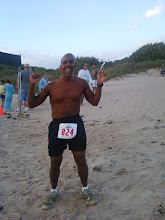
 Hey folks, I'm back in the thick of things. Namely, competition. I completed my first race this past Veterans Day weekend in almost 2 years ( I did do a 5k in Feb. 2012 , but while it was ok it wasn't as fast or good as this. Also I was hurting a little later).  This 5k was also a tough one, being held on the beach.

 First of all, I started running again in June, 6 days a week.Carefully of course. I also worked on strengthening some of those weak muscles involved, such as adductors and hamstrings ( through lateral kettle bell lunges and kettle bell swings). I also worked on trying to fix my structural imbalances. For example,my left hip is slightly higher than my right, thus causing movement compensation. Also I have almost flat feet. Fortunately, my friend and body corrective specialist, Ari Globerman, has shown me exercises to try to correct these. I also try to use a foam roller once a week to massage out the knots in my muscles.

 While one of my goals in June was to enter the race, it wasn't until about late Sept. or early Oct. that I actually committed to it, registering in Oct. It should be noted I had been running on the beach at least once a week. Usually 2 miles ( 1 mile one direction, then after a rest 1 mile back to the starting point). But after committing to it, I started going to the beach at least 3 or more times a week in the beginning. Then, this last month leading up to the race I went all 6 days a week. Remember, you want to train for specific events just like you're going to compete , especially those that tend to be more difficult (  a beach run, open water swimming,etc). Now this doesn't mean I ran 3.1 miles non stop every day. On the contrary, remember, like I've said in earlier posts, your central nervous system will shut down and you'll slow down if all you do is the same distance run at the same pace every day. I definitely mixed it up, sometimes 10 x 200 meters ( lifeguard tower to tower) , leaving on 1:30 intervals. Other days 8 x 400-500 meters ( using Guarded Beach signs to Unguarded Beach signs) on maybe 3 -3:30 intervals. I also did 1/2 mile intervals , 50-100 meter intervals, and even 4 x 1 or 1 mile + intervals. As you can see, interval training really helped. This isn't to say I didn't run longer distances. Each week, I would run a 4 miler, a 6 miler, and even 9 miles. In fact, the week before the race I ran 11 + miles on the beach. But even in these longer runs I would mix things up, sprinting for a short distance along with a slower pace, as well as running ( if you can call it that ) in the soft sand and running on the packed sand. In fact the 11 mile run was run at high tide. Try running in shin deep water, not to mention the mush underneath ( now I know what quicksand feels like!). Of course all beach runs were barefoot.

 A few days I would throw in a second run , on the street or on a bridge. However, aside from running I also wanted to keep up other physical activities. Since I was working Tues. -Fri., 11-1 and 4-6 , except for Wed. which was just 4-8, I would run in the morning and then go to the pool ( remember , I am a lifeguard here at the Indian River State College pool). If there was time, before and after work I would swim , although much of it was just drills and not high intensity laps except occasionally. Still, the swimming did burn some calories, and 25 yard no breathers definitely helped with the anaerobic system. The main work I did outside of running in the evenings was strength work. Already most of the year I had done both maximal strength ( dead lifts, military presses) and strength endurance ( pull ups, kettle bell swings, push ups, burpees, done in a circuit for example). Remember, strength training strengthens our muscles and bones, helping to decrease injury while increasing output.About 2 months ago I started to limit maximal strength to once or twice a week and started to add explosive strength a few times a week. Specifically, Olympic weight lifting. This type of training really helps with explosiveness and speed. Because of the intense nature ,depending on how much weight we use, reps are usually 1-2, and never more than 5 per set. Therefore , in order to get 20 reps,there are anywhere from 4-20 sets. Obviously, this type of workout can builds muscle, along with burning quite a few calories. Another plus for Olympic weight lifting. About a month ago ,I stopped maximal lifts ( although I do practice maximal strength body weight exercises such as 1 leg squats on my breaks at work ) and switched to explosive strength training 5 days a week, with circuits thrown in once or twice a week. For the past month, 1 circuit I've done for a little more than a month. It involves strength endurance, a little maximal strength, alot of explosiveness, and even some multi planar movements. I start of with 5 lateral hops over my 16 kilo kettle bell ( back and forth), then immediately I do 30 mountain climber ab exercises,with my hands on the kettle bell handle, then I go into the 2 hand swing for 30 reps, follow that with the kettle bell military press x 2 reps, and finally I box jump up and down on my weight bench, which is about 2 feet, for 5 reps. I do this for 10 sets with almost no rest between exercises. I also time myself, trying to beat the previous time. This workout lasts about 30:00 or so. Definitely a sweat storm!

 One other thing that changed out of necessity was the number of meals. Because my morning runs were on the beach obviously cooking my usual breakfast of oats and protein powder was out of the question. At the beach the water fountains don't necessarily work so I couldn't add water to my powder either. So basically I'd go to work afterwards, swim if I could, and then go home and breakfast would become brunch. And after my evening workout would come dinner ( chicken breasts or tuna, liquid eggs, and vegetables ).I believe in "earning" my meals, essentially not eating until some strenuous work has been done. I also feel one needs to eat according to how much work they do. This resulted in less calories, which in turn combined with my workouts resulted in my weight staying below 136 lbs and my fat % staying below 10%. Weight and fat % are also factors in athletic performance, especially running and pull ups. I'm not trying to say this is how you should eat, I'm just telling you what worked for me.

 Race day came and I was ready. My first serious race in almost 2 years. And my first race barefoot. After a good thorough warm up, I got in the front of the line, and off I went. While a little tough at first I soon got into a rhythm,  catching and then passing an individual. Conditions were also very good. There was very little wind and the shoreline was not moist sand but hard packed sand. Even when I would have to run through the small surf, the ground was still pretty firm. And not huge shells to worry about. Eventually I realized I was in the top 6 -8! But there were 2 bad things. 1 guy who's 48 was in the top 3. Even worse, race organizers didn't mark the turn around at the halfway mark for us top 10 or so. We all ran to the jetty at the end of the island. As we made our way back,  we saw a table on the beach, and a couple of guys telling people to turn around! I was furious and screamed some choice words. I later found out about 10 or more of us ran an extra 1/4 to 1/2 a mile! In spite of this I refused to give up and kept increasing my pace, picking off each runner that I could. I kept this attitude right to the finish line. 24:54! Afterwards officials called us 7 or 8 and told us they were aware of the mistake and they would take that into consideration. So, I managed to win my  age group, but not Masters this year. Originally I was listed as 10th ( which in itself was clearly wrong as all the other men said ) but after even more recalculating I was listed as 19th overall! I know that's wrong. I know the truth.

 Well, otherwise, everything turned out good. Besides the thrill of it all , I also wasn't hurting at all. I really paid attention to proper form. And I think all that training paid off. This is what I mean by prepare. Now I'll try to decide on what's next. Possibly Bridge Busters 5k in Jan. Or if everything works out right, finally the Miami Marathon. Getting there has been a major goal. And a story for another time.


Sunday, November 11, 2012

The Importance Of Multi Planar Movements

  Many injuries in physical activities are often caused by weak links, often called muscular imbalances. And one of the major causes of these imbalances is the lack of training in different planes of motion.
 When standing straight, the body is divided into 3 planes. The frontal plane divides the front and back half of the body. The sagittal plane divides the body into left and right halves. And the transverse plane divides the upper and lower body at the waistline. Movements occur in the different planes on an axis running perpendicular to that plane.

 Sagittal motions are flexing/extending motions, basically front to back. Examples include squats, running, curls, etc. Frontal motions are adduction/abduction motions, or side to side. An example would be a side lunge. Transverse motions involve internal and external motions of the body. Examples include hitting a baseball or golfing.

The problem is most people train overwhelmingly in the sagittal plane. But in real life we stop and turn, we move from side to side, basically we go in all types of directions. And because we don't train in different planes it creates muscular imbalances which often leads to injuries.

 So, we need to train in other directions . Exercises like side lunges ( especially with a kettle bell or dumb bell  ) and especially twists/ wood chop motion with a medicine ball can really cover those neglected areas. And only once or twice a week is necessary with this type of training. So get to it.

Monday, November 5, 2012

Proceed With Caution

That's not just a sign on the road, it also describes how you should plan your fitness program. There are a few factors to consider when making a program.
One is your current physical state , another is your athletic experience. Obviously if you're an Olympic athlete, learning  a new skill or trying for a new goal should be relatively easy. You'll still have to start from the beginning but at least you'll have it easier than most people. Examples would be Michael Phelps learning how to ski the Rocky Mountains or Floyd Mayweather wanting to learn rock climbing. On the other hand, if you've been living in Dunkin Donuts or gasp for air when you go to get the mail , you definitely have a long , long , road ahead of you . Don't expect to be doing much more than basic joint mobility and basic strengthening exercises in the beginning .
Another major factor is what are you trying to learn? If it's just a general basic fitness program ( lose weight, tone up, etc. ) that won't be super difficult. Again, basic exercises ( mobility and strength ) and maybe a little cardio along with proper nutrition will gradually and safely move you along. Maximal strength training ( squats, bench press, military press, and dead lift ) and even some strength endurance ( pull ups, push ups ) are relatively simple to learn and can be eventually ramped up to provide a greater challenge . These exercises do still require proper form ( especially the power lifting ) but still are pretty straight forward.
On the other hand things like rock climbing, swimming, gymnastics, and Olympic weight lifting, just to name a few, require an incredible amount of work. Professional instruction is definitely recommended for most of these. While some basic things can be done on your own , advanced work can be incredibly risky for the untrained. I myself take it to heart. I am currently working on 3 Olympic lifts, snatch and clean & push press or clean and jerk.You know how much I snatched tonight? A whopping 50 lbs. 5 reps x 5 sets, each rep carefully executed. And this was after an empty bar warm up ( 45 lbs ). And currently I've been averaging 70 lbs on my 2 clean lifts. I certainly will not be attempting a body weight lift, let alone double or triple body weight  anytime soon ( gold medalist Mathias Steiner can relax!). Not without professional instruction.
I do that because I've rushed things in the past and pulled a muscle and ended up out of commission, delaying progress even longer. The same rule also applies to when you're exhausted. Don't practice a highly technical thing , like an Olympic lift, or an incredibly difficult thing , like a jump over a wall ,when you're fatigued. I found out the hard way 2 years ago bout jumps and fatigue. After a 7 mile run on the beach , I decided to jump from a still position , up on to the top of cement picnic table! My extreme Ninja Warrior moment. Remember, not a running jump, a still jump. After 7 miles in sand. The table top was probably 2 1/2 - 3 feet high. My first attempt didn't make it. On the 2nd try, my shins crashed into the table. Ouch! I ended up with several stitches. Luckily I could still run although I couldn't swim for a couple of weeks. Also some leg exercises hurt. Clearly I shouldn't have jumped.
I hope you now understand the importance of step by step training . Careful practice can lead to success while rushing things can lead to ruin.

Wednesday, October 31, 2012

Looks Are Decieving

Last time I talked about how most gyms are a waste of time and money. One of the reasons is the ideas the gym and their trainers have. They almost always focus on looks and not practicality. Of course a big reason is because most of the general public has come to confuse looks with actual athletic ability. The gyms are just meeting the public's expectations.
How did this happen? Much of the blame goes to bodybuilding and media, especially models and movies. People equate huge muscles with strength, speed, and overall athleticism. But what people don't understand is that having a 25 inch biceps or rippling abs isn't necessarily going to make you a better fighter, swimmer, soldier,etc. In fact, some of these overdeveloped muscles could hinder performance. Most Americans, especially men, seek to build huge biceps, huge pecs, huge quads, and tiny waistlines.While the slim waistline is good, the other things are one of the reasons for muscular imbalances, which can hinder performance, and in some cases even lead to injury. Huge pecs can lead to slouching and is a negative in sports like swimming and boxing. Seriously, the muscles people should work on , but are overwhelmingly neglected, are lats , hamstrings, glutes, and forearms.
People think Mr Olympia is the symbol of excellence but they're greatly mistaken. Professional bodybuilders through much of the year use moderate weights with high reps, follow very tight , often unhealthy diets( I recall reading one guy restricted his water intake to tea spoons ), along with tons of supplements. On contest day they also use various oils to make their muscles stand out. Of course the final push comes from a bottle or a needle ( lots of diuretics and of course steroids ).Think I'm exaggerating? Read any bodybuilding magazine. Most are quite honest. Look at the guys. There are champions who are under 5"10 yet weigh over 300 lbs!It's all for looks. They however are not necessarily super strong or fast unless they train specifically for such things.
TV and movies have also given us false ideas. One of the worst is Mike " the situation" from Jersey Shore. What can he do, besides shots? Even the Italian Stallion Stallone isn't real. I remember as a kid reading how he had 2% body fat during Rocky 3. Yeah, but he was living on  raw eggs and tuna, getting mercury poisoning in the process. No real boxer would train like he did. That's not to say boxers wouldn't train hard and eat right, becoming lean and muscular ( think Paciao or Mayweather ) but they certainly wouldn't be dizzy all day ( like Stallone himself admitted).
It wasn't always this way. The first bodybuilders, at the turn of the 20th century, would demonstrate feats of strength, as well as showing off their muscles. Guys like Arthur Saxon and Eugene Sandow ( who the Mr. Olympia trophy is named after ) would lift barbells with 1 arm or bend steel bars, while their muscles would stand out. This became the first display of muscles. But these guys, while bigger and defined than most people, they certainly weren't anywhere near the size of todays bodybuilders. Even the first wave of "modern bodybuilders " ( Arnold Schwarznegger, Franco Columbu, Dave Draper, Serge Nubret,etc.) trained for strength most of the year  ( heavy bench presses, heavy squats,etc.) with limited emphasis on sculpting ( flyes, tricep extensions,etc.) only during contest time. And they weren't built like dinosaurs ( Arnold at his peak was 6'2  and weighed 235 , a far cry from todays guys ).
Many people now equate size with strength , and even ridicule the lean, muscled look. 1 guy on Amazon, reviewing Pavel Tsatsouline's excellent strength training book , Power To The People, made the ridiculous claim that Tsatsouline  looked like a prisoner from a Soviet gulag! Pavel is 6'1, 175-185 lbs. While definitely no Mr. Olympia, the man hardly looks like that. I think that shows where the reviewers mind is. Pavel has also dead lifted 3 times his weight, can do 20 pull ups, and military press a 80 lb + kettle bell. His "gulag' like muscles seem to be doing just fine.
Remember, guys like Bruce Lee, Michael Phelps, Usain Bolt, and Manny Paciao may not come in a Calvin Klein ad or appear in Flex magazine, but their lean muscles certainly produced results .

Monday, October 22, 2012

What Do I Have Against Commercial Gyms?

Many commercial gyms are a big part of the problems in the fitness industry. Notice I didn't say all. There are definitely some good gyms out there but to paraphrase Bruce Lee " 90% of commercial gyms are baloney" ( or some stronger words ).
Actually in most cases the gyms philosophy of training isn't the problem. The one exception I can think of is Planet Fitness ( aka Planet Fit less or Planet Fatness ).Their so called " judgement free zone " is really a no progress zone. Seriously, alarms going off when you exhale, staff rushing up to you when you do a strenuous lift. While everyone doesn't need to dead lift double their body weight , doing only light lifts always will definitely not improve anything. In fact, it's a way of keeping people out of shape, and thus constantly dependent on the gym.
The 2 biggest problems with most gyms are the trainers and equipment. Most trainers are poorly paid and make their money through commissions ,thus the often high pressure sales pitch . Also, most trainers themselves only know accepted ideas ( work every body part individually, static stretch before you work out,etc. ) and have limited real world experience  using fitness( competitive athlete, military vet, first responder ) .
The other problem is the equipment most modern gyms have . 90 % of  the equipment are machines . As I've mentioned in previous posts , machines take away your supporting muscles , move you through the same range of motion every time, etc. Seriously, it doesn't mean anything if you can do 100 pec deck flyes. On the other hand , a double body weight bench press or 100 push ups takes serious effort and will work your chest , triceps, and many supporting muscles . There are a few reasons for all the machines. They're much easier to use so gym owners get those. Also like the trainers I mentioned earlier, many gym owners have wrong ideas about what works. Finally, they can get more clients in a gym with machines. Free weights on the hand are not as appealing to much of the public. This gets to their bottom line, the gyms profits. They want alot of clients , and if they can get them to take a personal trainer that's even better for the gym. They want to get as many people as they can, and get them in and out of the gym .
Part of the problem is also the public's perception of what works. Often some people won't even hire a trainer if they don't work in a gym. I guess they never heard of  Pavel Tsatsouline, Stew Smith ,  or Mike Mahler . All those guys have proven themselves athletically many times over ,Smith in particular in his 7 1/2 years as a SEAL. These guys also don't work for any gyms  ( although they do sometimes hold seminars in a gym ). Most of Smith's work outs are in fact done in parks.
Now there are definitely good gyms with good trainers in them. Crossfit Witchita,Tx. has strength coach Mark Rippetoe for example. Pat Flynn works out of the Dragon Gym in Pa. Clearly there are exceptions. The problem is finding the good ones if you want a gym. Many good trainers will work with you at your house, the park,etc. But if you don't want a trainer and just want to work out on your own here are a few things to look for. Make sure the gym has lots of free weights. You would also probably want a bench and squat rack although these may be unnecessary. Other useful things would be kettle bells and dumb bells. Depending on your goals you may want to look for specific things like a heavy bag ( for boxing and martial arts ) and a pool ( obviously for swimming ).
I'm not trying to scare you but I'm trying to show you the facts , saving you some big money in the process and hopefully still reaching your goals.                                                                                                

Saturday, October 13, 2012

The Value of Circuit Training

Circuit training is essentially doing one exercise after another , with little to no rest . This is a great way to build strength endurance , burn fat, build muscle , work the whole body ,as well as work different adaptations.
Circuits generally use 1 or more pieces of equipment although it's  not an absolute requirement. I do believe you will make faster progress with a mix of equipment and body weight exercises. Suspension equipment ( TRX, Jungle Gym, etc.) , dumb bells, and especially kettle bells are all great equipment to work with . The kettle bell is especially valuable because of its versatility as well as the sheer number of exercises that can be done with it. Weights on the other hand are less than ideal for circuits . Weights are generally for maximal strength ( 1-3 reps ) as well as the fact that you'd have to waste time changing the weight between exercises . This isn't to say it's impossible but either you would have to lower the weight  or limit the number of exercises.
The exercises you choose should be relatively simple , although not necessarily easy . Examples would be push ups , pull ups, military presses , swings . Usually you want to do moderate to high reps ( 3 - 10 + ) depending on the exercise , although you could do a 1 rep exercise in the circuit as long as there was enough time to recover . The number of sets can range from as low as 3 to as high as 10 or more .
Here are a couple of examples . 1 circuit I did the other day. It was a mix of maximal strength , strength endurance, and a little explosiveness . It also worked grip , pushing, and pulling strength . I did 16 diamond push ups , then using my 16 kilo ( 36 lbs ? ) kettle bell , I held it with the handle down ( known as the bottoms up grip ) and did 5 lateral lunges  ( for both legs ) , then immediately 5 bicep pull ups ( the pull up bar in my room ) , and ran back to the kettle bell and did the 2 hand swing for 25 reps . I  immediately got back down in push up position and started it all over again .I did this for a total of 10 sets. That's a total of 160 diamond push ups , 50 lateral lunges , 50 bicep pull ups, and 250 swings . This type of mixed training has recently been termed metabolic resistance training . Another goal is to try to beat the previous time . In the above work out , last week I did this in 42:06 . This week I did it in 40:36 . I did the same amount of work in less time . That's progress.
This morning I did a circuit on the beach that focused on explosiveness and speed. I did 2 hand swings with the kettle bell x 25 reps, the hopped laterally over the kettle bell x 5 reps, the immediately sprinted to the shore and back to the kettle bell ( about 20 -50 meters , much in soft sand ) .I did this for 10 sets in 16 :15 . Notice the overall reps were much lower as well as the overall time . That's because this was a much more intense circuit ,namely the jumps and sprints. However the results are more than perfect.
As shown , circuits don't have to be limited to the gym . You could swim laps and alternate them with body weight or resistance exercises. The only limitation is your imagination .
And if you want to add an extra fat burning element , consider some non stop aerobic exercise immediately afterwards . In the example of my 2 circuits , after the long 40:00 circuit I ran a mile . After the beach circuit I ran 4 miles on the beach .
I would recommend at least a couple of circuits a week although more won't hurt . I would say however not to do the exact same circuit more than twice a week , if even that  ,and certainly not 2 days in a row .
So get your equipment ready, set your timer, and go.

Sunday, October 7, 2012

The Importance of Anaerobic Training

There's a  view that training should always be long duration. This is especially true in what are considered aerobic activities , ( any activity over 30 seconds ) mainly running , swimming, and biking. Some strength training programs also train in an aerobic manner . This training is viewed as very good for the heart and as the best method for conditioning , as well as helping people to burn fat . People often train in what's commonly called " long slow distance " training ,i.e 30 + minutes , often a an hour or even more.
While there's a place for such training it's not necessary for everyone . For endurance athletes like marathoners , long distance swimmers, and long distance bikers such training is a must. But even they shouldn't always train long and slow . And for most people , there's no need for long workouts, at least not all the time . What's often overlooked is anaerobic training . Anaerobic simply means no or little oxygen is used . Obviously such activities are very short, often only a few seconds . Sprinting is most often associated with anaerobic activities but other examples include bench presses , Olympic snatch , and gymnastic somersaults. These are stop and start activities that don't last long . They do however require intense effort.
2 articles I recently saw really drive home that point . One at naturalrunningcenter.com ,  was ironically an article on building endurance .But part way down ,the article mentioned incorporating some sprints into your training in order to make your running complete . The other article, at livestrong.com , lists the many benefits of sprinting including , increased oxygen capacity , greater fat burning , as well as shaving time off your runs . Training in a long , slow , pace all the time will eventually lead to staleness, and even regression . I know because it happened to me . Some years ago after my success in my first half marathon ( first in my age group ,1:34 ? , 7th overall ) I tried to take it even further . I also thought about trying a full marathon , as well as misunderstanding how good runners train, i.e. , 10+ miles a day . Well I started to run at least 10 + miles a day , often finishing Saturday with a 13 + mile run .Remember ,I mean 10 miles at the same pace for the most part .The first week was pretty good but by the second week my times started to go up . I tried to mix up the speed but I found I couldn't bring the speed . I was devestated .I was only trudging through . I changed my training ,  bringing short sprints like 100 meters on an interval, into the picture . I also cut the mileage , and never ran the same amount twice a week . After awhile my speed returned and my times went back down.
While I mentioned running just now ,the same rules apply to other activities like swimming and even strength training . Lifting the same light weight every day or doing the high rep, low intensity ab work will eventually work against you . You need to throw in some short intense work outs such as 1 or 2 rep heavy lifts or a few  explosive jumps . Such intense work as mentioned earlier improves your vO2 max , your maximal oxygen capability , and builds muscle , among other things.
So remember , whatever your goals , a little intensity goes a long way.